
Antimonial Lead Ingot
 Antimonial lead, also known as hard lead or dry lead, is a rigid lead alloy produced by adding a certain proportion of antimony to pure lead metal. This alloy is available in both hard and soft variants, each finding diverse applications across various industries. Antimony, a chemical element classified as a metalloid, shares with lead a bluish-white metallic luster, making the alloy visually similar to pure lead while offering significantly enhanced mechanical properties.
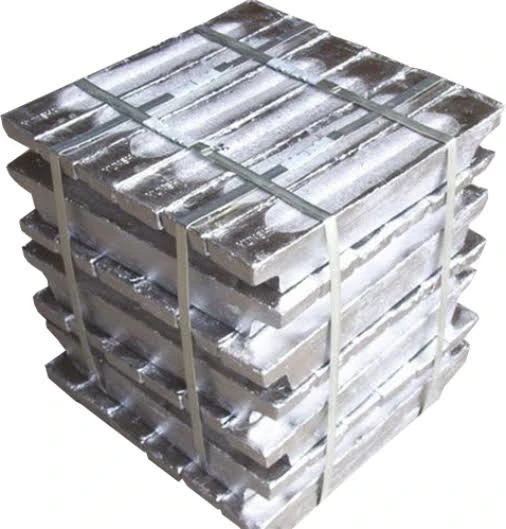
Lead Ingots: Comprehensive Overview from Crude to Antimonial and Ultra-Pure Grades
A lead ingot is a soft, heavy, and malleable piece of metal, typically cast in the form of billets, rods, or rectangular blocks. It is produced through the melting and solidification of either pure lead or lead-based alloys. Lead itself is a bluish-white metal, renowned for its remarkable malleability and ductility. However, the term "lead ingot" covers a broad spectrum of grades—from crude raw ingots to antimonial hard alloys and ultra-refined high-purity variants—each serving distinct industrial needs.
Crude or raw lead ingots represent the most basic commercial form of this metal. They are soft, workable, and classified as heavy metals due to their high density. Their outstanding resistance to corrosion, combined with a relatively low melting point, makes them indispensable across numerous sectors. Common applications include lead-acid batteries for automotive and backup power systems, protective cable sheathing, bearings, cathode ray tube glass, counterweights and balance scales, construction materials for soundproofing and vibration damping, chemical processing equipment, and the broader automotive battery manufacturing industry. Their ease of casting and forming, coupled with durability in harsh environments, ensures that crude lead ingots remain a staple commodity worldwide.
Antimonial lead ingots, also referred to as hard lead or dry lead, represent a crucial category of lead alloys. These are produced by adding controlled quantities of antimony—a metalloid element with a bluish-white metallic sheen similar to lead itself—to molten pure lead. The resulting alloy exhibits significantly increased hardness, mechanical strength, and dimensional stability compared to unalloyed lead. Antimonial lead is available in both hard and soft grades, depending on the antimony content, which typically ranges from 1% to over 12%. The hard variants offer superior rigidity and wear resistance, making them ideal for battery grids, especially in starter batteries that require structural integrity to withstand vibration and active-material shedding. The softer grades, with lower antimony percentages, are used in applications such as cable sheathing, chemical plumbing, and radiation shielding, where some malleability is still desired. Beyond batteries, antimonial lead finds extensive use in the production of shot pellets, bearing metals, type metals for printing, and decorative architectural cladding. The addition of antimony also improves the alloy's castability, allowing for intricate shapes with sharp details.
Moving beyond antimonial alloys, the refined lead ingot with 99.98% purity—and even 99.99% in exceptional cases—represents the pinnacle of quality. These are the "Porsches" of the lead world, produced through sophisticated electrolytic refining processes or sourced from exceptionally pure sulfide ores like high-grade galena. This ultra-pure grade has trace impurities—particularly bismuth (Bi) and silver (Ag)—reduced to parts-per-million levels. Industries with extreme sensitivity to these contaminants, such as semiconductor manufacturing, high-precision solders, nuclear shielding components, and specialized chemical apparatus, exclusively rely on this premium material. Even minute amounts of bismuth or silver can embrittle the metal, alter its electrochemical performance, or compromise coating integrity.
Regardless of grade, all lead processing demands stringent environmental and occupational safeguards. Lead is a cumulative neurotoxin; exposure to its dust, fumes, or soluble compounds poses serious health risks. Modern foundries employ closed-system furnaces, HEPA filtration, and continuous atmospheric monitoring to comply with regulations. Encouragingly, lead achieves recycling rates exceeding 95% in many developed nations.
In conclusion, from crude ingots powering global transportation, to antimonial hard lead enabling durable batteries and cast components, and ultra-pure grades serving advanced electronics, lead remains irreplaceable. Its unique combination of density, malleability, corrosion resistance, alloying versatility, and recyclability ensures that lead ingots in all their forms will continue to serve industry for generations to come.